Bridewell Hospital
Bones & AllBridewell Hospital is the institution where Maren finally visits Francis Yearly, her long-absent father, and encounters the material consequences of his illness and confinement. The hospital is at once a guarded, highly controlled place and a setting of ordinary patient routines; that contrast complicates Maren’s expectations and frames her meeting with Francis as an encounter with both a person and a history she has reached too late to hear from him directly.
Setting and controlled access
Bridewell stands at the edge of a hill in Tarbridge, Wisconsin: a three-story redbrick asylum with barred windows. Maren and Lee reach a guard shack where the parking lot meets a tall wrought-iron fence. A uniformed security guard asks whether they are visitors, records the car’s license plate, and allows them to proceed. The sequence makes the hospital’s boundary tangible. A family visit begins not at a bedside but at a gate, under institutional supervision.
The hospital is identified to Maren as a mental home, and its director, Dr. Worth, confirms that Francis is very sick. In her tidy office, medical textbooks line the shelves; a frog-shaped glass paperweight sits on the desk without holding down any papers, and a large brown water stain marks the ceiling. The parking lot is visible from the windows. These details place clinical authority and the outside world in the same room, while Maren waits for permission to see her father.
Maren offers her birth certificate as proof that she is Francis’s daughter. Dr. Worth does not examine it; she opens a folder and explains her concern that a visitor after so many years could upset him, as well as Maren. The exchange establishes that access is not simply a matter of kinship: the institution weighs the possible effects of reunion on both people. The visit proceeds, but the warning gives the encounter an uncertainty that the hospital’s locked doors will make physical.
The common room and its patients
Inside, the hospital does not match Maren’s imagined picture of an asylum. The common room has a radio tuned to classical music. Patients of different ages play checkers or solitaire, write letters, or paint watercolors; some wear pajamas, others ordinary clothes. Maren sees no one raving or struggling, and carefully limits that observation to what she herself witnesses. The scene refuses the sensational image she had expected, replacing it with a quieter institutional routine.
That quiet does not make the patients fully visible to one another or to visitors. A pale-haired girl in a shapeless gray sweater sits by a window overlooking the woods, her hands folded in her lap and her expression fixed on the possibility of rescue by fairies. The girl makes Maren think of Rachel, a personal association that brings another woman’s institutionalized life into the scene without claiming that the two patients are alike in every respect.
Other patients glance up as Maren passes, then look away when it becomes clear she is not bringing food or medication. Their attention does not last long enough to make her part of their world. One woman in a wheelchair knits with blunt-tipped plastic needles, steadily producing a scarf that gathers in her lap and disappears into a large floral handbag. She works without looking at the needles. The immense, seemingly purposeless scarf becomes one of the hospital’s most memorable sights: evidence of practiced activity, but also of a routine whose destination remains unseen.
Francis’s locked room
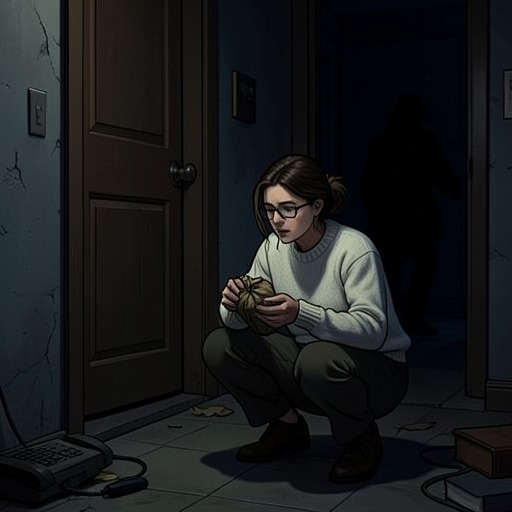
Travis leads Maren through swinging doors and down a long corridor. At the door at the far end, he takes keys from his belt. Francis is locked inside three times over, a description that turns the hospital’s general security into the immediate condition of the visit. In the room, Francis sits with his back to the entrance at a small padded table. Before Maren can see his face clearly, she notices the bed: white pillow and sheet, with leather restraints hanging from the side rails. The restraints are present but not in use; their readiness nevertheless shapes her first view of the room.
Travis introduces Maren to Francis with exaggerated tenderness, as though speaking to a small child. Francis does not initially turn toward the door. The contrast between the common room’s shared activities and this locked room’s restricted encounter marks the hospital as more than a single uniform environment: patients move through different degrees of access, and Maren reaches her father only after passing several layers of doors and keys.
The notebook and the unfinished visit
Francis has written a notebook for the child he did not know by name or even know whether to imagine as a boy or a girl. Travis brings it to Maren after finding it; it is about fourteen years old, its marbled black-and-white cover yellowed and its pages crinkled by old spills. Maren initially mistakes it for her own journal because it is so horribly familiar. The notebook makes the hospital a place where a relationship can be addressed across years of absence even when its author can no longer answer freely.
The handwriting is difficult to read, and Francis’s eyes are wet as Maren begins. His opening addresses an unknown child and admits both his longing for a visit and his fear that the child will hate him. He also recognizes that the child’s mother may never have told them about him. The writing records what a face-to-face conversation may not be able to supply: Francis’s uncertainty, his wish to be found, and his awareness that he might be unable to answer questions by the time his child arrived.
When Maren leaves, Francis gropes for her hand and tries to squeeze it. She does not promise to return soon. At the doorway she stops and insists on knowing what he did to his hand; Travis gently moves her aside, locks the door, and answers that she already knows. The exchange leaves the cause unstated in this scene, but makes the damaged hand part of the visit’s unresolved history. Bridewell’s doors close again around Francis, while his notebook remains with Maren as a message written in anticipation of precisely this encounter.